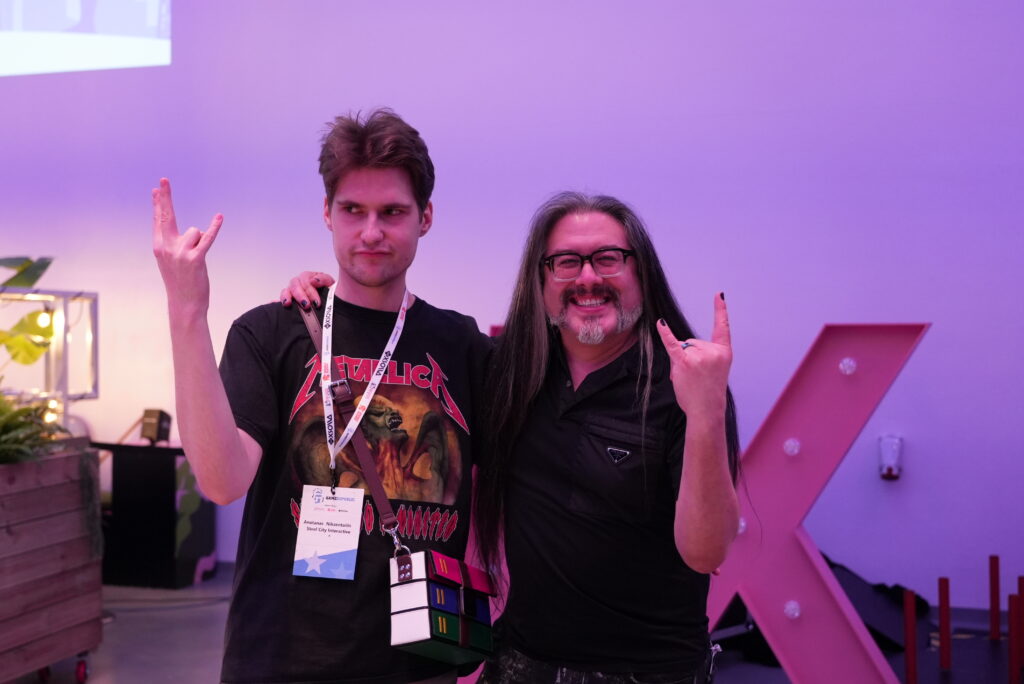

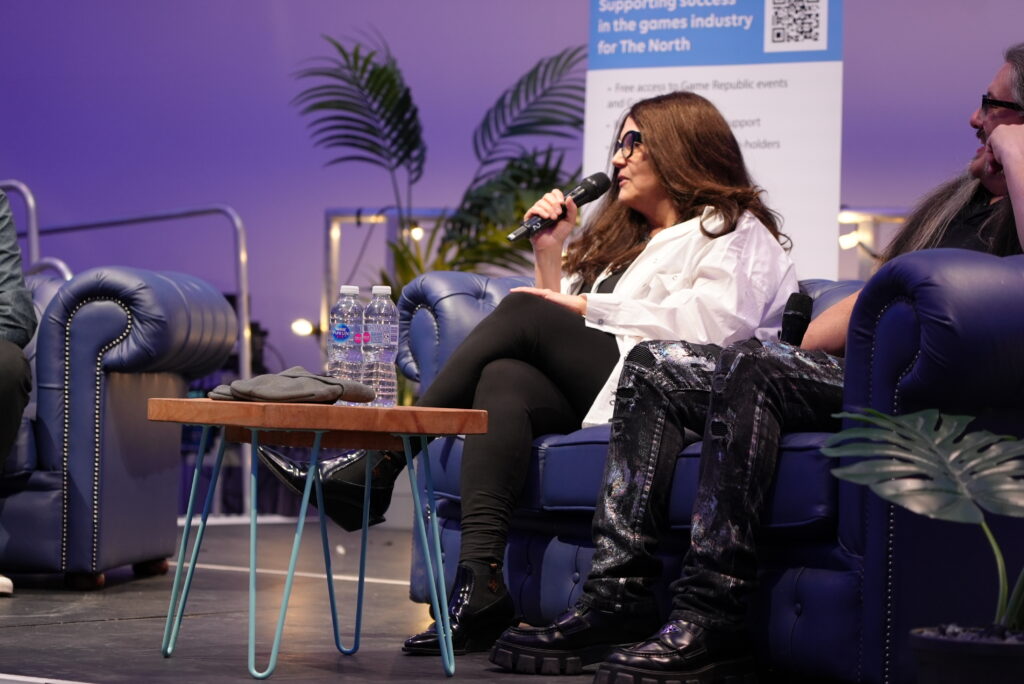
Kieran Gladwin a third and final year of Games Design at York St John University and an aspiring level designer/ Indie developer summarises the fireside chat hosted by Jamie Sefton, featuring the godfather of the first-person shooter – John Romero and BAFTA award-winning designer and artist Brenda Romero. The talk focuses on aspects such as the birth of the FPS genre, the resilience of independent studios and technical limitations of the 90s. The fireside chat took place at an event called “Dark and Doomy” at WX in Wakefield and formed part of the 2026 Game Republic event programme supported by Red Kite Games, Xsolla and Double Eleven.
Romero Games
The talk began with a brief look into a modern independent development studio, Romero Games. John Romero began with an update on Romero Games’ current first-person shooter project, recently facing a significant hurdle when their publisher pulled funding last July. Rather than giving up, the team saw this challenge as an opportunity to pivot. Instead of continuing with a massive scope, they streamlined the game’s design to fit a smaller, more focused team while retaining the original characters and core elements.
“Our publisher basically pulled our funding last July… decided that it would be better for us to just have a much smaller team going forward with the game… It’s a more streamlined focused design and I’m really excited about it.” – John Romero, Co-founder, id Software
When asked about a timeline for the project, Brenda Romero offered the classic developer’s mantra: “When it’s done.”
Humble Beginnings
Both developers reflected on their entry into the industry during the 80s. Brenda’s entry into games development was famously serendipitous, she landed her role at Sir-tech Software at age 15 during a high school cigarette break. A chance encounter with someone looking for a cigarette led to a conversation about Wizardry and Dungeons & Dragons, revealing Brenda was a Dungeon Master, which served as her impromptu job interview. This led to a 20-year career with the company, heavily focused on the Wizardry series.
“…Wizardry was like D&D but on a computer […] and so I just played, oh my god, I played all the time. And I remember like that to me was just that’s what magic felt like.” – Brenda Romero, CEO and Co-founder, Romero Games
John’s journey was fueled by an intense passion for coding and arcade games. After teaching himself how to program in 1979, he secured his first industry job in 1987 at Origin Systems, converting the RPG 2400 A.D. from the Apple II to the Commodore 64.

The Birth of FPS
John recounted the founding of id Software with John Carmack, Adrian Carmack, and Tom Hall. The shift toward 3D shooters began abruptly: while working on a new Commander Keen game for two weeks, the team recognized the potential of their new 3D engine and proposed they pivot towards making a 3D version of Castle Wolfenstein. Wolfenstein 3D was built and shipped in just four months.
“So the next day, goodbye Commander Keen, we’re starting to work on Wolfenstein 3D,” John recalled, noting that “from the idea to shipping, [it] was four months to make that shareware version come out”.
The team brought the same confidence and rapid iteration when developing Doom. John reminisced that they had even issued a press release calling it “the best game in the world” before development had seriously begun.
“Yeah, well when we started to make the game we put out a press release saying this is going to be the best game in the world. Can you believe it?” – John Romero, Co-founder, id Software
Most interestingly, the game’s revolutionary multiplayer mode, which coined the term “deathmatch”, was added onto the game just a month and a half before it was released. They also deliberately built the game with longevity in mind: “Let’s make it super open so they can make the game look like not even Doom, like anything”.

Expanding Horizons
Brenda also discussed her pivot away from traditional RPGs. After 20 years of working with swords and fantasy, she sought out different challenges. This led her to work on unique titles such as the fighting game Def Jam: Icon and Playboy: The Mansion, a fascinating magazine publishing simulation in which she had to navigate strict rules regarding the brand’s intellectual property.
New Technologies
While Doom was incredibly fun to make, the transition to full 3D with Quake was gruelling. The original vision for Quake was a D&D-style world where the player controlled a super-powered character with a hammer, similar to Thor, but the extreme technological demands forced the team to pivot and heavily reduce the scope. It took 11 months simply to build the engine before the team could actually begin designing the game, a process John described as “mentally destroying for everybody”.
John used this experience to illustrate why modern games take so long to develop: “heavy” 3D engines require massive amounts of data, polygons, and complex animations just to build the basic framework of a game.
“…we just make a 2D sprite and we can throw it in the game like really quick. That doesn’t even happen [now] unless you’re making a 2D game.”– John Romero, Co-founder, id Software
 A Legacy of Resilience and Innovation
The fireside chat highlighted the immense resilience required to thrive in the games industry, whether navigating the technological hurdles of the 90s or managing the harsh modern realities of game publishers. The conversation also touched on the importance of preserving gaming history, with Brenda highlighting a newly funded documentary directed by filmmaker Theresa Loong that chronicles a decade of her life and career.
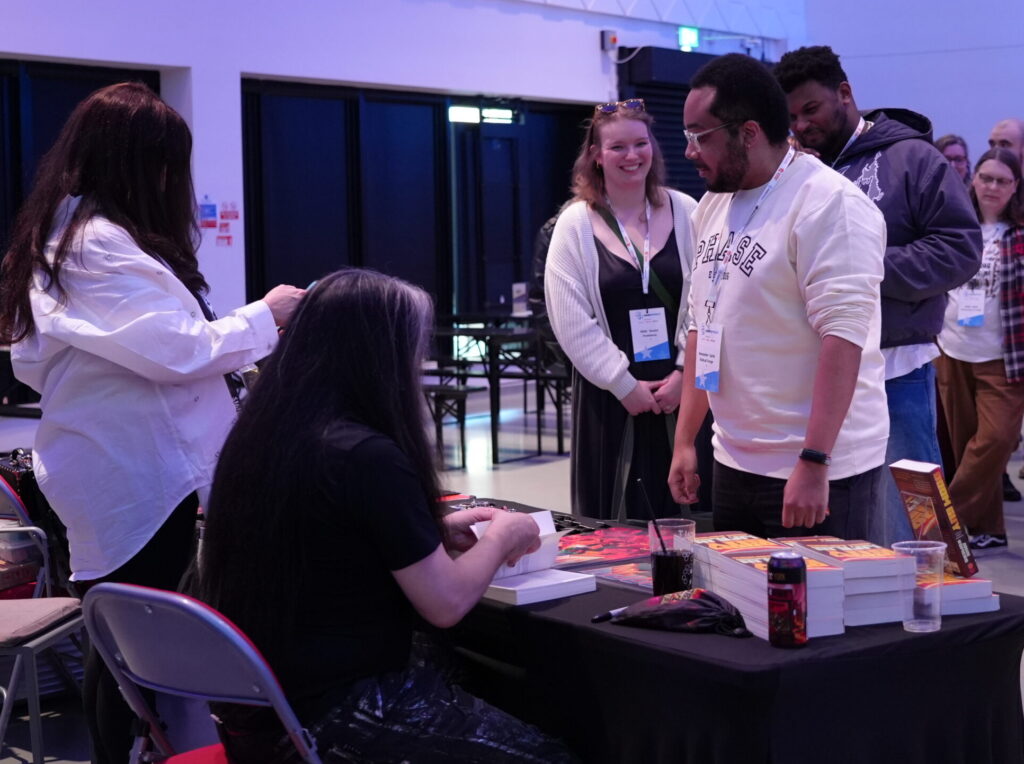
As host Jamie Sefton drew the insightful session to a close, the energy in the WX was far from fading. For the next few hours, attendees formed queues, waiting to meet the legendary duo, get their merchandise signed, and snap a photograph with two of the industry’s most foundational creators.
This event was FREE for Game Republic members
If you are interested in becoming a Game Republic member, affiliate or educational partner to come to events for free, get business development support and join the network you can apply to join Game Republic here.