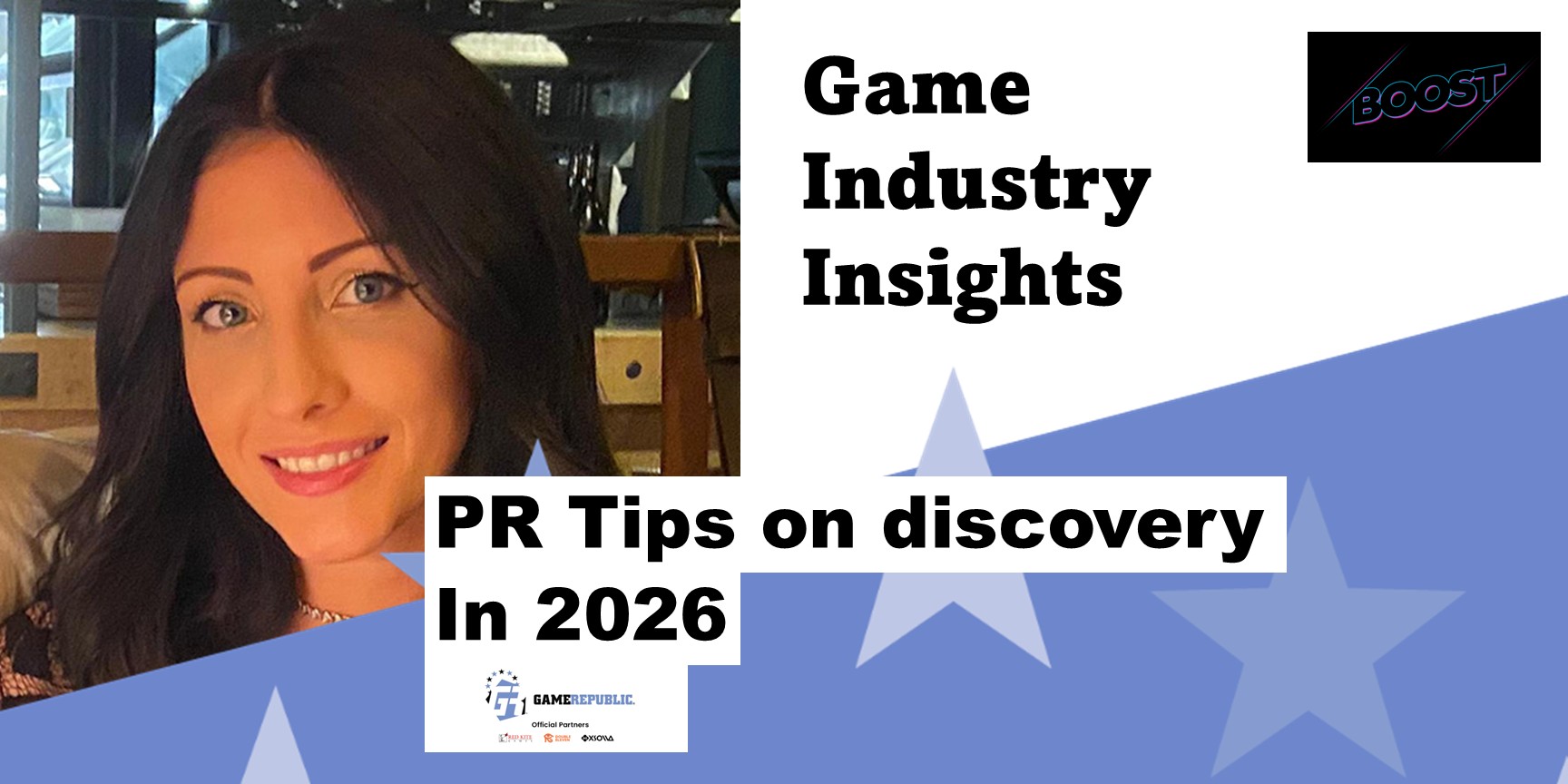
Co-Founder of Boost Communications Becky Attard delivered a presentation to a room packed full of game industry professionals at Game Republic Trends and Opportunities event hosted at Manchester Metropolitan University on 28th January. Gerald Allen Antoine, a student studying for his MSc Computer Games Development at Manchester Metropolitan University summarises the practical guide to communications (comms) for indie developers she shared at the event that was designed to meet them where they were, with suggestions and practical advice that fit the limited resources many indie teams can typically have. The event formed part of Game Republic’s events and activities for 2026 supported by Official Partners Red Kite Games, Xsolla and Double Eleven.
Four key aspects of game communications
Becky Attard started her presentation by defining what communications actually is by breaking it down into four key aspects.
Clarity, or being able to explain what your game is in simple terms, was the first aspect Becky identified.
Posting or otherwise being present regularly but not every day, was the second.
The third was connection, which she defined as speaking to humans and not ‘audiences’.
Conversion was the final aspect, which Becky defined as the process of making it easy for the people you communicate with to wishlist or buy your game.
What kinds of messaging to use when communicating about your indie game
“players don’t buy features. They buy feelings.”
Becky next provided the audience with a messaging framework that included three key pillars to help developers build their messaging about their game. The first pillar was the emotional fantasy, which Becky defined as “the feeling players chase with your game.” Next was the signature mechanic or “the mechanic that defines the experience of your game.” The last pillar was the world and tone, meaning “the atmosphere, flavor, and personality of your game.”
Following up on the three-pillar framework, Becky gave us some tips to remember in helping to craft our messaging. The first was “players don’t buy features. They buy feelings.” Becky also advised the audience to avoid genre soup in their messaging. Her last tip was that the language used should feel alive and include verbs, imagery, and rhythm to sound more human and less corporate.
Positioning your game
“as soon as you can describe the game, that’s when you should start thinking about what that [position statement] is and start shaping your messaging.”
Becky then moved on to discussing how to turn your three key pillars into a position statement or “a guiding sentence that captures everything in your game.” She explained that position statements prevent genre soup and messaging drift, help collaborators, press and players understand your identity, and make every communication faster, clearer, and more consistent. To create one, we should start with the emotional fantasy, move into signature mechanics, and anchor it in our world and tone. Becky provided the example of “a lonely descent into a fallen kingdom where every secret asks what you’re willing to become” as a positioning statement for Hollow Knight.
The question of when to start thinking about comms was Becky’s next topic. She advised that “as soon as you can describe the game, that’s when you should start thinking about what that [position statement] is and start shaping your messaging.” Another good time to start, according to Becky, is once you have something visual to show off that can start generating interest. She emphasized that we should start thinking about comms before building our Steam pages, saying “if you don’t look at your messaging before you build your Steam page, your Steam page will just look like a flood of features.” The audience was also advised to start conceptualizing comms before cutting the first trailer of their games. Finally, we were told that we should definitely consider comms long before we need press or influencers, as it will be very helpful for establishing relationships with them early on in your development.
Best communication channels for promoting your game
Next, Becky shared a tiered list of communication channels to help identify which channels were essential, which were nice to have, and which were optional. The top tier, the must-haves, included Steam, trailers, one social platform, and a website or link hub. Tier two, the high-value extras, consisted of devlogs, press kits, and Discord. The optional channels making up tier three were TikTok, Reddit, newsletters, and in-person events. The key thing, Becky noted, was “you don’t need to be everywhere. You just need to be repeatable”.
We then moved on to learning how to build momentum on comms without burning out. Strategies for this included re-using content across platforms, building a weekly “comms hour” to focus on comms efforts, documenting development instead of inventing content, using templates for comms to help streamline announcements and patch notes, and creating a ‘minimum viable presence’ plan.
Strategies for engaging with press and influencers
“press and creators cover games that are easy to understand, easy to access, and easy to talk about.”
The next topic in Becky’s guide was establishing effective strategies for interacting with press and influencers. She started by stating “press and creators cover games that are easy to understand, easy to access, and easy to talk about.” There were different strategies presented for influencers and press. Influencers want a fun game with a clear hook and permission to be themselves. We were advised to make keys for the game easily accessible and avoid scripts, restrictions, and approval steps. In contrast, journalists want unique angles, human stories, surprising mechanics, and cultural moments. Becky admonished the audience that the press is not looking for messages like ‘we added 12 new levels’ or ‘we’re launching soon’.
Becky presented six tactics that fit into the overall strategies for working with press and influencers. These included having a clear, compelling hook, providing a playable build and clean, ready-to-use assets, making your pitches short and respectful, timing your communications so they do not coincide with large industry events and similarly busy periods for press, and establishing relationships instead of cold-calling people.
Becky concluded her presentation by telling us “communications isn’t about shouting. It’s about helping players find the thing that you’ve poured your soul into. Small, consistent steps beat those big, sporadic ones…and your voice matters as much as the game. Be human. For indies it becomes more important to understand the person building the game.”
To find out about events on the Great Northern Games Discord, GaMaYo and Game Republic events and webinars visit the events page.
If you are interested in becoming a Game Republic member, affiliate or educational partner to come to events for free, get business development support and join the network you can apply to join Game Republic here.
To provide the best experiences, we use technologies like cookies to store and/or access device information. Consenting to these technologies will allow us to process data such as browsing behavior or unique IDs on this site. Not consenting or withdrawing consent, may adversely affect certain features and functions.
Functional
Always active
The technical storage or access is strictly necessary for the legitimate purpose of enabling the use of a specific service explicitly requested by the subscriber or user, or for the sole purpose of carrying out the transmission of a communication over an electronic communications network.
Preferences
The technical storage or access is necessary for the legitimate purpose of storing preferences that are not requested by the subscriber or user.
Statistics
The technical storage or access that is used exclusively for statistical purposes.The technical storage or access that is used exclusively for anonymous statistical purposes. Without a subpoena, voluntary compliance on the part of your Internet Service Provider, or additional records from a third party, information stored or retrieved for this purpose alone cannot usually be used to identify you.
Marketing
The technical storage or access is required to create user profiles to send advertising, or to track the user on a website or across several websites for similar marketing purposes.