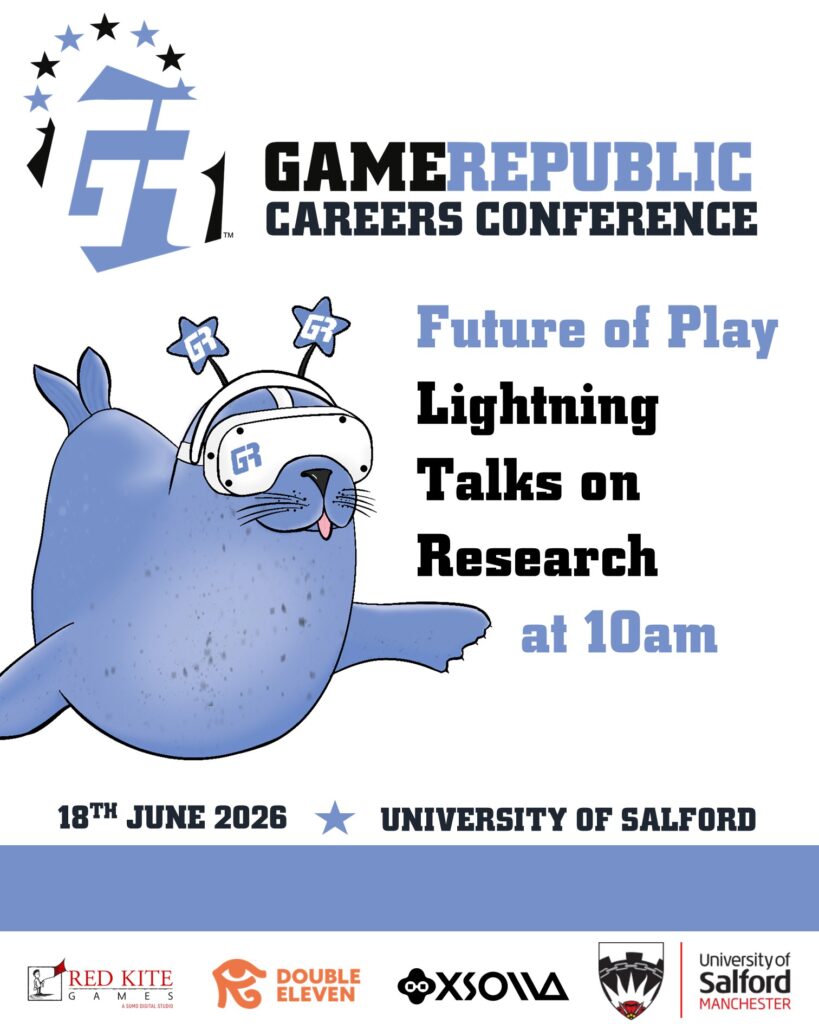
Researchers from Universities, colleges and companies from York, Leeds, Salford, London and Manchester will come together for an inspirational Lightning Talks session on 18th June at 10am. The research topics selected are wide-ranging and will include evaluating happiness and relaxation in multiplayer games, the impact of music on game play immersion, games and its impact on real world problems and action, the challenges of narrative design and quick wins from feedback, game design to enhance work place dynamics, game engines and how they impact real places, how games are impacting cultural experiences and engagements, techniques for teaching people from wide ranging backgrounds and what six year olds can teach us about generative game design. Each talk will last 5 minutes and will be followed by panel discussions and questions chaired by Dr Juan Hiriart from the University of Salford. The event forms part of the Game Republic events programme supported by Official Partners Red Kite Games, Xsolla and Double Eleven
Below we share the summaries of the research from the relevant lead researchers themselves that will be presenting the lightning talks on 18th June
Adam Hart – University of Salford
Ecological Citizenship in Youth Work through Minecraft ‘In the Green’ and ‘In the Blue’
This presentation will share a youth work approach using Minecraft to facilitate playful, educational conversations about the natural environment.
Minecraft provides and accessible, engaging, and versatile space for exploring complex societal and environmental issues, such as climate change and sustainability (Amadori, 2020; McNally & de Andrade, 2022). This can enable young people to shape discussion around issues that impact their lives. Research suggests that creative, arts-based engagement cultivates emotional investment and deeper understanding of real-world problems (Burke et al., 2018; Doyle, 2020), empowering young people to contribute to meaningful conversations about citizenship, sustainability, and social change.
We have conducted several projects exploring how Minecraft can be used to support engagement with biodiversity, sustainability, and ecological citizenship. Activities were informed by the National Youth Work Curriculum (NYA 2024), which has the four cornerstones of participation, equality, education and empowerment. This provides a playful and creative way of engaging with these issues, as well as a forum for young people to share knowledge and become agents of change.
Alex Brooke, Manchester Metropolitan University
Prediction of Discrete Emotional Intensity in a Multiplayer Game
While player experience modelling has matured significantly over the past decade, existing work often focuses on solo play and aggregate measures such as positive affect and overall preference. Our work therefore lies at the intersection of two under-explored topics within this domain, applying player experience modelling techniques to data collected from a multiplayer game, and using this to predict the intensity of discrete emotions such as Happiness and Relaxation, collected using a validated self-report tool.
Firstly, we introduce a bespoke multiplayer test-bed game designed for remote collection of data describing behaviour and affect in non-laboratory settings.
Then, we evaluate the utility of feature groups aligning to three levels of increasing logistical complexity, namely: using data from the game itself; data collected purely from participant’s webcams during the gameplay experience; and data combining the two, summarising player’s reactions to in-game events.
Each feature group was tested both for linear relationships with the target emotional scales, and as input to a series of predictive models developed using cross-validation and topology optimisation.
Results suggest that estimation of discrete emotional intensity in a multiplayer setting presents a significant challenge, with linear relationships between input variables and the target emotional subscales often weaker than expected (r < ±0.4). Predictive model performance again suggests difficulty in the task, with the greatest improvement over a baseline approach highlighting expression metrics related to player conversation as those providing the greatest utility.
Given the wealth of existing work utilising facial expression features as input for user-responsive games, we discuss potential limitations of such an approach, and highlight how future work may benefit from further consideration of the “social noise” and inter-player dynamics inherent to multiplayer environments.
While player experience modelling has matured significantly over the past decade, existing work often focuses on solo play and aggregate measures such as positive affect and overall preference. Our work therefore lies at the intersection of two under-explored topics within this domain, applying player experience modelling techniques to data collected from a multiplayer game, and using this to predict the intensity of discrete emotions such as Happiness and Relaxation, collected using a validated self-report tool.
Firstly, we introduce a bespoke multiplayer test-bed game designed for remote collection of data describing behaviour and affect in non-laboratory settings.
Then, we evaluate the utility of feature groups aligning to three levels of increasing logistical complexity, namely: using data from the game itself; data collected purely from participant’s webcams during the gameplay experience; and data combining the two, summarising player’s reactions to in-game events.
Each feature group was tested both for linear relationships with the target emotional scales, and as input to a series of predictive models developed using cross-validation and topology optimisation.
Results suggest that estimation of discrete emotional intensity in a multiplayer setting presents a significant challenge, with linear relationships between input variables and the target emotional subscales often weaker than expected (r < ±0.4). Predictive model performance again suggests difficulty in the task, with the greatest improvement over a baseline approach highlighting expression metrics related to player conversation as those providing the greatest utility.
Given the wealth of existing work utilising facial expression features as input for user-responsive games, we discuss potential limitations of such an approach, and highlight how future work may benefit from further consideration of the “social noise” and inter-player dynamics inherent to multiplayer environments.
Alex Flint – IGGI University of York
Test the Story, Not Just the Game: Quick Wins for Indie Narrative Testing
Indie developers widely recognise the value of testing narrative early. Understanding how players interpret, engage with, and emotionally respond to a story can shape stronger player experiences and prevent costly redesign later. However, in practice, early narrative testing is often not feasible. Limited budgets, time constraints, and a lack of accessible games user research (GUR) knowledge mean that testing is frequently delayed until a playable prototype exists – by which point key narrative decisions are harder to change.
Drawing on interviews with indie developers working on narrative-focused games, this talk highlights a central challenge: while developers want early feedback, they often lack practical ways to test narrative without a finished or near-finished build. As a result, narrative evaluation often relies on informal methods such as self-testing, feedback from trusted game dev peers, or playtesting at events. These approaches can be useful, but they are inconsistent and rarely designed to capture both player understanding (e.g. clarity of plot, character motivations) and player experience (e.g. emotional engagement, pacing).
This creates an opportunity for quick wins. The talk introduces lightweight, low-cost approaches that allow developers to test narrative earlier – without requiring full prototypes or extensive GUR knowledge.
By focusing on practical, approachable, and accessible strategies, this work contributes to the democratisation of GUR, enabling indie teams to make more informed narrative decisions earlier in development. Supporting early narrative testing helps reduce reliance on intuition alone and leads to more intentional, engaging player experiences.
Amit Pate – Orio Games
Title: “This Is Boring, Daddy”: What a Six-Year-Old Taught Us About Generative Game Design
The most honest playtester on our team is six years old. She does not care that the game was generated by a state-of-the-art AI model in forty seconds, or that the engine behind it represents two years of research. If the character moves too slowly, she puts the laptop down. If the world looks empty, she walks out of the room. Her verdict — “this is boring, Daddy” — has retired more features than any sprint review.
This lightning talk is a practitioner’s field report from inside Orio, a platform where 3D games are co-authored conversationally between a human creator and a generative AI. We argue that the arrival of prompting as play is not a new tool in the designer’s belt; it is a post-digital rupture in what authorship, design, and play even mean. When a six-year-old can describe a game into existence, edit it by complaining at it, and abandon it without ceremony, the boundaries this conference is asking us to interrogate — between maker and player, between industry craft and informal practice, between the digital artefact and the embodied life around it — collapse on a kitchen table.
We will share three observations from our alpha community of five hundred creators that surprised us: how non-coders are developing a new literacy of describing, how players treat generated worlds as drafts rather than products, and how a 90% week-one return rate is being driven not by spectacle but by agency.
We close with a question we cannot yet answer, and would like to bring to this room: when the harshest critic in the house is six, and the engine never tires, what is a game designer for?
Anthea Nelson – SupaManager
Süpamanager®: Play as a Portal to Better Work
We spend a third of our lives at work, yet the workplace remains one of the least designed spaces for human flourishing – süpamanager® is a game that dares to change that — not through policy documents or training decks, but through play.
Sitting at the intersection of tabletop game design, organisational psychology, and social theatre, süpamanager® invites players to inhabit the dynamics of workplace culture from the inside out. By framing managerial behaviour, communication, and power as game mechanics, it renders visible the invisible rules that govern professional life — the hierarchies we absorb, the silences we perform, the relationships we negotiate daily without ever naming them.
Artistically, süpamanager® draws from traditions of applied theatre, serious game design, and participatory experience — work that uses fictional frames to surface real truths. It owes as much to Pep Guardiola as it does to Augusto Boal’s Theatre of the Oppressed, positioning itself as a playable provocation rather than a product.
Culturally, it arrives at a defining moment. Post-pandemic, workers everywhere are re-examining what they owe their employers — and what they deserve in return. Games that hold up a mirror to that renegotiation carry genuine social weight.
Süpamanager® is not escapism. It is a structured invitation to look clearly at how we lead, follow, speak, and stay silent — and to imagine doing all of it better. That is the future of play: not fantasy, but clarity.
Callum Steele – Leeds Beckett University
Exploring Methodologies to Assess the Effects of Procedural Music on the Gaming Experience
There is a wide range of methods for measuring gameplay immersion and how this is affected by music, yet very little specifically tailored towards the extent to which a game score can be procedurally generated before it becomes the law of diminishing returns. This presentation puts forward the development of a game in which all music is generated within the game engine at the level of granular, additive and subtractive synthesis, and samples.
Three studies are assessed that measure responses to music and the gaming experience in order to develop a process for measuring the success of this level of procedural music through quantitative and qualitative means. Practitioners creating games and game adjacent art in Unreal Engine are cited to demonstrate just how far the technology to enable a creative vision have come, while success as taken from the player experience is based on established measures of immersion, enjoyment and replayability.
Daniel Maktabl – Manchester School of Architecture
Title: From Portrait to Presence
Game engines are commonly known to play a role primarily in the entertainment and commercial media production industries. In this presentation, however, we will ask how game-making technologies can be used for heritage interpretation to generate new forms of encounter between contemporary audiences and significant historical figures.
Within museums and heritage contexts, historical figures are often presented through portraits, archival materials, and artefacts. While these methods remain valuable, they position the audience as a mere ‘observer’ of cultural heritage. This project attempts to tackle the issue by introducing the possibility of interacting with a historical figure within a curated virtual environment.
We present that real-time interaction can support more active forms of historical engagement, where visitors are invited to approach, question, interpret, and experience cultural history through immersive and real-time participation.
In the presentation, we attempt to outline a possible workflow for transforming historical material (historian accounts, portraits, artefacts, etc) into interactive digital twins within game-engine environments. We will present a proof of concept: a working prototype of a digital replica of King Charles II, developed for the ‘stories of the palace’ project with the National Horse Racing Museum, Newmarket, to demonstrate how decisions around representation, digital place making, spatial context, human-like interaction, and immersive experience become part of the process.
This research contributes to discussions around post-digital heritage by positioning the real time engines as more than a tool for just visualisation. In doing so, the project offers an instance for rethinking how GLAM institutions can use immersive media and interactive spaces and characters to make cultural history more participatory and engaging responding to contemporary demands.
Jack Murrell – Blaze Games
From Tutorials to Industry
Many aspiring game developers begin their journey through tutorials, online courses, and formal education. These approaches are highly effective for building foundational technical skills, but there is often a gap between learning how to use a tool and applying that knowledge independently within a production-focused environment.
Drawing on experience delivering Unreal Engine bootcamps and industry-facing training programmes, this presentation explores the role that project-based learning, employer engagement, and practical problem-solving play in helping learners bridge the transition from education to industry. While technical skills remain important, progression is often determined by a learner’s ability to work through uncertainty, communicate ideas, collaborate with others, and develop confidence in their own decision-making.
The presentation will reflect on observations from supporting learners with diverse backgrounds, including career changers, graduates, and aspiring developers entering the games sector. It will consider how academia, training providers, and industry partners each contribute different but complementary elements to learner development, and how stronger collaboration between these groups can create more meaningful pathways into employment.
Rather than focusing solely on technical instruction, this session invites discussion around the experiences that help learners move beyond tutorial-following and towards greater technical independence. The aim is to explore how education and industry can work together to better prepare emerging talent for the realities of modern game development.
Neta Yodovich – University of Salford
From Research to Production: Knowledge Exchange and Co-Creation in GAMEHEARTS
This paper explores collaboration between academia, industry, and cultural organisations through the Horizon Europe-funded GAMEHEARTS project. Bringing together universities, video game companies, football clubs, museums, and orchestras, GAMEHEARTS examines how video games are reshaping contemporary cultural experiences and audience engagement.
Focusing on knowledge exchange and co-creation, the paper reflects on collaborations with partners including Ubisoft, Manchester City F.C., and the London Symphony Orchestra. It considers how academic research can inform production contexts, audience engagement strategies, and creative practice, while also examining the challenges of cross-sector collaboration between organisations with different priorities and working practices.
The paper argues that meaningful collaboration between academia and industry depends upon ongoing dialogue, mutual adaptation, and shared approaches to cultural innovation. In doing so, GAMEHEARTS offers a case study of how research and production can productively intersect within the contemporary creative industries.
Research students wishing to attend the event should contact tutors for the FREE ticket code or join the Game Republic Student Club should apply here – please note to apply you must use your University or college email address.
The event is free for students attending Universities and colleges that are Game Republic Educational Partners
Universities and colleges who would like to find out about becoming a Game Republic Educational Partner should contact us here
For students not attending these Universities and colleges, please see the event link to book a spot
If you like this post, please help us by sharing it!